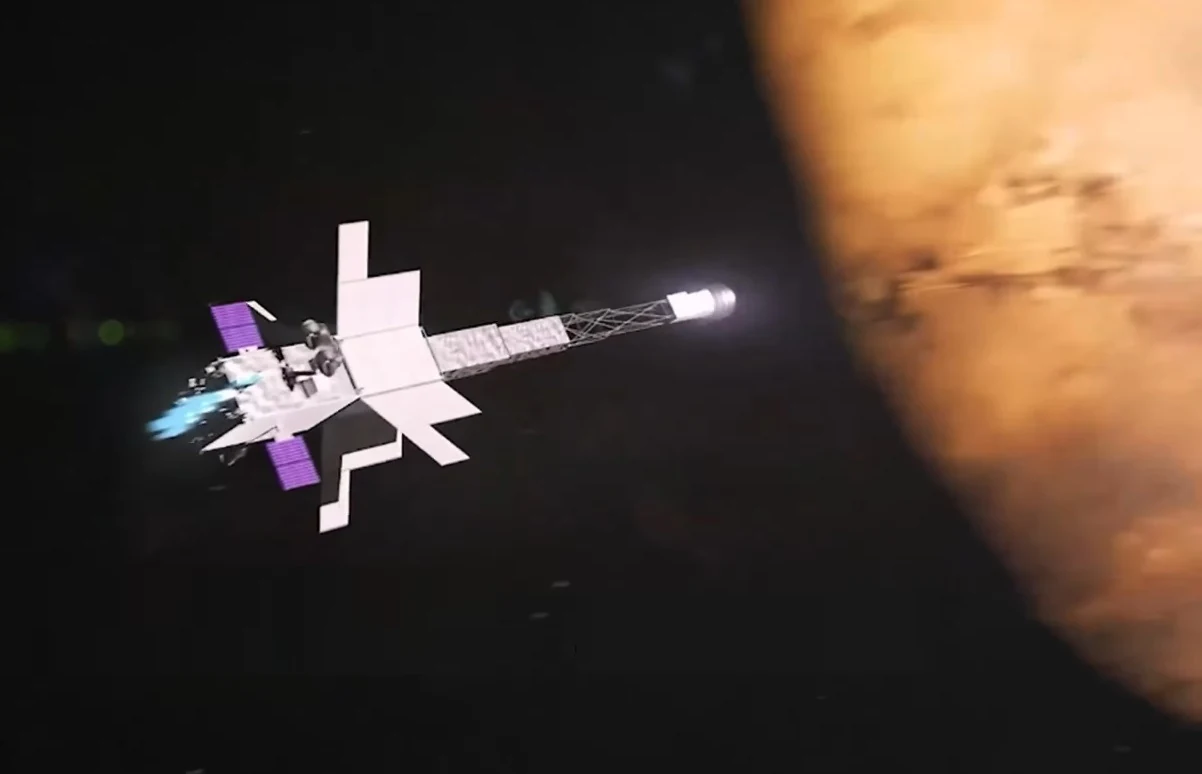
NASA's leaders today laid outan ambitious multibillion-dollar space exploration planthat calls for building a moon base over the next decade and launching a nuclear-powered probe to Mars by 2028.
The space agency is also pressing the pause button on its multibillion-dollar plan to create a moon-orbiting outpost known asthe lunar Gateway, and on its plan fortransitioning from the International Space Station to commercial outpostsin low Earth orbit.
Instead, NASA says it aims to work with commercial partners to procure a government-owned Core Module for the ISS. That module would serve as the attachment point for commercial space modules that could eventually detach to become free-flying space stations.
Meanwhile, the Power and Propulsion Element that was designed for the Gateway would be repurposed for the Mars probe known as Space Reactor-1 Freedom. SR-1 Freedom would be powered by anuclear electric propulsion systemand drop offa payload capable of deploying three helicopters in the Martian atmosphere. Such a mission, known as Skyfall, builds on the success ofNASA’s Ingenuity helicopter on Marsand parallelsa concept proposed last year by AeroVironment.
NASA is aiming to launch SR-1 Freedom, land astronauts on the lunar surface with its Artemis 4 mission and start laying the groundwork for a moon base with Artemis 5 by the end of 2028, when President Donald Trump’s term in office comes to a close.
During a series of briefings at the agency’s headquarters in Washington, NASA Administrator Jared Isaacman made clear that Trump’s national space policy, pluscompetition from China’s space program, was the motivation for the quick pivot and tight timeline. “When I say that success and failure comes down to months, we mean it,” he said.
Isaacman also acknowledged that meeting the schedule will be challenging. Just last month, he announced that the date for the first crewed lunar landing since 1972would have to shift from 2027 to 2028, due in part to delays in SpaceX’s development of a lunar lander.
Few disagree with the direction we are taking, but many question the achievability,” he said in amessage to NASA employees. “There is a belief among some that NASA has drifted so far from its best days that we can no longer undertake big, bold endeavors and deliver on them. That is why we must take ownership of the outcomes. We will not sit on our hands and hope industry saves the day.
An artist's conception highlights elements of a future moon base, including inflatable habitats, pressurized rovers, transport ships, drones and power facilities. (NASA Illustration)
NASA estimates the cost of the moon base program over seven years at $20 billion, and the total cost over the next decade at $30 billion. Isaacman said “a very decent portion” of that projected outlay was previously earmarked for NASA’s Gateway program.
We’re just focusing on the main needle-moving objectives in line with the president’s national space policy,” he said. “Gateway isn’t canceled, but we get a lot of hardware that we’ve already invested in.
Sen. Ted Cruz, the Texas Republican who chairs the Senate committee with oversight of NASA’s budget, endorsed the plan in apost to X.
Space is not just symbolic. It is strategic,” he wrote. “A sustained lunar surface presence ensures America, not China, leads the next era of exploration. That is why my bipartisan NASA Authorization Act, which the Senate Commerce Committeeapproved this month, includes provisions that will support NASA in this effort to make an American moon base a reality. I look forward to continuing to work with NASA to maintain American superiority in space.
Other commentators were more skeptical, particularly about the prospects for launching nuclear-powered probe by 2028.
Absolutely no one I know who has expertise in spaceflight or planetary exploration thinks this is either remotely plausible or a good idea to attempt on such a timeline,” Katie Mack, an astrophysicist at the Perimeter Institute for Theoretical Physics,said on Bluesky. “The dominant reaction is somewhere on the spectrum between mockery and dismay. Real, important science was canceled for this.
Chase Million, a former NASA researcher who went on to found a data analysis company called Million Concepts, said the changes in the agency’s space exploration plan were “unsurprising to most of us, but many details are shocking or confusing.”
For the next few weeks, NASA personnel are going [to be] crushed by questions from the community that they will have trouble answering,”Million said in a Bluesky post.
Here are a few more details about the elements of NASA’s new plan:
• Moon base and more:NASA envisions a three-phase campaign to establish a permanent presence on the moon. The first phase calls for increasing the tempo of robotic lunar missions — including theVIPER rover, theLuSEE-Nightradio observatory and a fleet of rocket-poweredMoonfall reconnaissance drones. The second phase would focus on building semi-habitable lunar infrastructure, and the third phase could send uppermanent habitatsandheavy-duty lunar rovers.Radioisotope batteriesandnuclear reactorswould be developed to power NASA’s moon base. • Going nuclear on the way to Mars:NASA hasalready been working with other government agencies and commercial partnerson nuclear reactor concepts that would be suitable for in-space propulsion. SR-1 Freedom’s reactor would generateelectrical power for an ion thruster. Steve Sinacore, NASA’s program executive for Fission Surface Power, said the ability to adapt Gateway hardware could accelerate development of the SR-1 Freedom spacecraft. He also said questions about what happens to the spacecraft after it drops off its Skyfall payload are “still open.” • Tripling down on Mars helicopters:The Skyfall mission relies on a dispenser to send out three helicopters during its descent through the Martian atmosphere — a method that’s somewhat similar to the“Sky Crane”that was used for NASA’s Curiosity and Perseverance rover missions. Instruments on the helicopters could be used to survey potential landing sites and other areas of interest. • Rethinking commercial space stations:Dana Weigel, NASA’s program manager for the International Space Station, said the markets for in-space services such as privately funded research, manufacturing and space tourism haven’t matured as quickly as NASA expectedwhen it established its Commercial Low Earth Orbit Destinations program in 2021. “The original path we laid out is fraught with a lot of higher risks,” she said. Among the ventures that have received NASA funding for space station development areAxiom Space,Starlab Space(co-founded by Voyager Technologies and Airbus) andOrbital Reef(led by Blue Origin). Now those players and other companies will be asked to come up with new ideas that could lead to the procurement of a Core Module for NASA, plus space modules that could become free-flying commercial outposts after the ISS is retired. The current plan calls for the ISS to bedeorbited in the 2030-2031 time frame, and Weigel said NASA will try to ensure that commercial alternatives are available by the time the ISS goes away. “It’s really important for us to maintain continuous presence,” she said.